 |
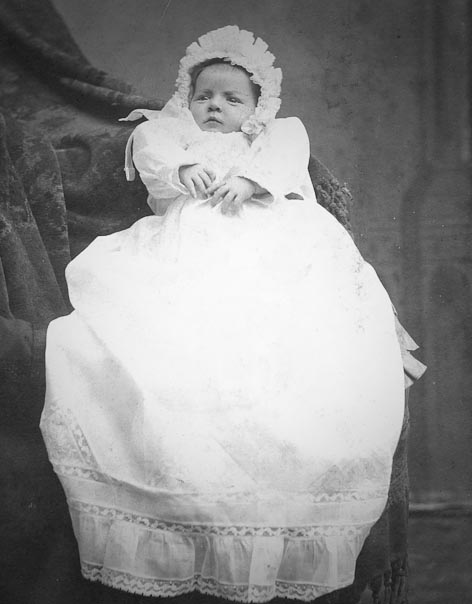
| Leonilda Marie Antoinetta Verzone in her christening gown. |
Leonilda Marie Antoinetta Verzone was born on February 24, 1911. That makes her 100 years old next week. A great accomplishment, but the path through a life is complicated and full of joys and sorrows, surrounded by family and friends.
Nana’s life began in New York City. Born to immigrant parents, she was an American citizen at birth. When she was 40 days old it was decided that New York City was no place for her to be raised, and her mother and grandmother took her back to Italy while her father stayed behind working as a waiter at the venerable Plaza Hotel. The trip to Italy was marked by the fact that Nana’s grandmother fell and broke her leg, and upon arrival in Italy she recuperated slowly. Nana’s mother soon returned to America, and the small child was left behind, moved from aunts to cousins and eventually to her paternal grandmother.
 |
| Ernesta Verzone and Leonilda Verzone circa 1916, Biella, Italy |
At an early age Nana could never understand being left alone in Italy in the care of her grandmother. The only explanation seemed to be that World War I precluded sending her home. Letters would be exchanged and money would be sent for her support. The only connection to her family would be the occasional photographs that would be mailed to daughter and her grandmother. The small town in northern Italy was called Brusnengo, and it was here that Nana would go to school and play along the steep slopes of the fields surrounded by vineyards and small family “palazzinas” — villas. Her stories of her youth were full of trips to Torino and Biella. Brusnengo is still a small and beautiful town and very much like Canton in many respects. There is a strong community of “townies” who have lived their whole life in that place, and festivals gather neighbors throughout the year. Nana’s stories always stoked my imagination of her childhood home, and while she loved being with her grandmother, America was always pulling her dreams across the Atlantic.
 |
| Brusnengo in 1925 |
Nana’s grandmother had a wonderful mouthful of a name: Rose Luigia Maria Teresa Ernesta Verzone. For short, her name was Ernesta, and she was born to the DeFabanis family in 1859 and was raised in Fiano, Italy. It is easy to see the affection for all things Italian in a family, which, like many Canton families, can trace a significant lineage back to “the old country.” Ernesta was a schoolteacher, a widow, and also the maternal head of the “familia.” This strong woman ran the family concerns in Italy – her ledgers are detailed and track the rise and fall of the family fortunes in Brusnengo. She was the correct person, at 52 years old, to raise young Leonilda.
 |
| Leonilda's U.S. Passport Photo taken in Italy |
Finally, in 1922, the letter from her father arrived — simply — “send my daughter to New York and I will meet her upon arrival.” Arrangements were made, her passport was issued in Rome on March 17, and five days later she arrived at the port city of Genoa. At age 11, and by herself, she boarded the passenger ship Giuseppe Verdi as one of the 1825 third-class travelers and began the 17-day passage back to her homeland. She slept on the upper bunk so her feet would remain dry. The bunks were arranged in wards, and the ocean water was frequently awash on the floors. At a top speed of 16 knots, the days seemed like eternity to this wide-eyed girl who could only speak Italian.
Every photo tells a story, and the passport photograph that was taken for the trip to the United States shows a confident 11 year old in a new blue dress made from wool and decorated with simple embroidery. The dress had been handmade especially for the trip, and while her grandmother wanted a simple front, the dressmaker insisted that as she was traveling to America the style called for something more sophisticated. In the photo, she is adorned with tiny pearl earrings in each ear and a matching necklace. On her right shoulder her virgin hair is extremely long, and in fact when she came to Boston it would be cut for the first time — the hair saved, to this day, in a small package in a dresser drawer as a relic from her childhood.
Upon arrival in New York City, Nana would not have to go through immigration as she was already an American Citizen, and yet on April 8 she was in fact becoming an American for the first time. She had never met her father, yet she often told the story of arriving at the top of a majestic flight of stairs at Ellis Island and at the bottom stood the “most handsome man in the world.” After a night in New Jersey, the train trip to Boston brought her to the venerable Copley Plaza, where her father, Emilio Verzone, was the headwaiter, his brother being the maitre d’hotel after successfully managing the “Plaza” in New York.
Hotels and hospitality were a family business, and in the 11 years that Nana was in Italy the family had begun to moderately prosper. The Verzone family lived on Columbus Avenue, and since Nana’s departure a sister was born and the family consisted and older brother and a five year old sister, and soon anther brother would be born. Quite simply, the family outgrew the rental brownstones of Back Bay. Fellow waiters at the Copley Plaza hotel told Emilio of Canton, where dozens of northern Italian families from Gattinara had settled. Family names so familiar to us today: Bertiletti, Crevola, Zanazzo, Carrara, Piana, and Dardano all trace their lineage to the Commune of Gattinara, which was close to Brusnengo, Emilio’s hometown.
 |
| The Verzone children Hugo, Leonilda, Gino and Florence |
In Canton, the family settled on Walpole Street in a large farmhouse with a barn and several acres of fields along the Neponset River. The house that Nana would now call home was filled with laughter, her new brothers and a sister, and plenty of characters. The smells of rabbit, polenta and risotto would fill the warm kitchen. To make ends meet, Emilio would rent out rooms to Italian boxing contenders who would travel to Boston for prizefights. Glorious stories would be shared with this new little girl who would be amazed by the newness of it all. The dining room was a mix of English and Italian languages flowing over the house, sternly attended by a father and mother who slept in separate beds for most of their life. So much to learn about this new place, it was as if life exploded around her and Canton would be her new home for a lifetime.
Nana attended Canton Public Schools, and her brother Hugo would teach her English and she would take care of her sister Florence and baby brother, Gino. Her childhood transition from Brusnengo was complete. She writes in an early letter on Copley Plaza Stationary, “tutti un bacio con me” — a kiss to all from me.
Next week, we continue Nana’s story as she grows up, gets married, and finds a life in Canton.
This article originally ran in the Canton Citizen on February 17, 2011.

