Sunday, May 8, 2011

Remembering the Civil War


Company A, the Canton men who were the first to leave Massachusetts
in the Civil War, shown here at a reunion on September 17, 1898.
(Photo by J. W. Wattles, Courtesy of the Canton Historical Society)
It may be cliché to say that you can touch history, but in all honesty, our history is made up of the places, artifacts and stories that we preserve for future generations to “touch.” Nowhere is this more evident than in the new exhibit at the Canton Historical Society that lays bare the artifacts brought back by Canton soldiers from the American Civil War.
Affectionately, I have always called the “Histy” Canton’s Attic. The building itself was completed 100 years ago and the Classical Revival building with a modest exterior holds thousands of photographs, artifacts and stories that create a link to our place here in Canton. The Historical Society has been collecting and preserving our history since 1871, when it was founded by a group of men to “obtain and preserve all material that would throw light upon the history of the town.” Many of these men fought in the Civil War, and they carefully placed their artifacts into the building for safekeeping.
It must have been with great pride in Canton and in our military role in the Civil War that prompted Wally Gibbs, the president of the society, to begin work on the current exhibit focusing on the Civil War. As Mr. Gibbs examined the holdings in the vault, and in musty drawers and boxes, he put together the story of war that is poignant and memorable. Each object selected is a direct connection to the intense hardship of battle and the bloody trials endured by our boys as they fought a war on home soil.
The history of Canton is intertwined with the Civil War. More than 600,000 men died in battle and even more would return home with disfiguring wounds on both their bodies and minds. Canton’s resident historian, James Roache, recounted the heavy loss of life from Canton: “In a town of almost 3,500 inhabitants, Canton would suffer the loss of 30 men in battle.”
The names of our lost men are inscribed on the memorial tablets that flank the interior at Memorial Hall. Our town hall is in fact a memorial to those who lost their lives in giving the ultimate sacrifice for freedom. The soldier who once stood outside Memorial Hall, and now is in a corner of the interior, was a tribute to the soldiers of Canton. Today, observe the patina of the statue, weathered and beaten, silently watching the tax collections and dog licenses.
A Union soldier's cartridge case.
In the Canton Historical Society it is in the ordinary that we touch the extraordinary. There is the pewter plate used by Larra E. Wentworth in 1863. The Union canteen carried by Captain John Hall. And most touching is the simple tin plate that was picked up at Wilderness, Virginia, along the rebel lines. Buttons, belt buckles, and dress swords fill a case where time stands still and the battles have ended.
There are Union guns and Confederate rifles. The most interesting of these guns is the Confederate single-shot rifled musket that was taken from the battlefield at Bull Run. The rich, dark wood, smoothed by time, bears a rip from a Union bullet that tore the gun “from the hands of a South Carolinian rebel.” The force of the direct hit on the gun sent the weapon flying and wounded the rebel soldier. Attesting to the force of the shells are two bullets that met midair, united by the impact. The ammunition quieted but still telling tales.
The Civil War bugle owned by Wallace McKendry
from Ponkapoag (Photo by George T. Comeau)
Also long quieted is the bugle that belonged to Wallace McKendry. The son of Captain William McKendry and Harriet Billings, McKendry was born in Ponkapoag and enlisted in Company D 22nd Regiment and served as a sergeant in the Peninsular Campaign. The cloth cord and tassels are intact, and the owner’s name is simply engraved.
Most remarkably, the Histy owns the two dress swords worn by the grandsons of the patriot Paul Revere. These two men, Paul Joseph and Edward Hutchinson Robbins Revere, were heroes in the truest sense. Upon the call of duty, Paul Joseph Revere would leave a wife and two children. A dear friend urged him not to leave home, to which Revere remarked, “I have weighed it all, and there is something higher still. The institutions of the country — indeed free institutions throughout the world — hang on this moment.”
The war stories surrounding the two Revere men from Canton are the stuff of movies, and sadly of life during war. Space precludes sharing the list of heroics as well as the tribulations. Suffice it to say that imprisonment, torture, hostage exchanges, glorious battles and, ultimately, sacrifice and death, paint a vivid portrait of the lives of these Cantonians. Both of these men represent the covenant with the Union and freedom, offering their lives to consummate the ideals of the United States of America.
The Revere men stand elegant in a large framed portrait above the door to the society vault that contains their military dress swords. Ask Wally Gibbs to see the swords, and touch a rare piece of Revere family history. Edward Revere’s sword is simple and tells the story of the surgeon who died heroically on the battlefield of Antietam on September 17, 1862. Colonel Paul Joseph Revere’s sword is engraved with the names of the battles in which he took part. Ball’s Bluff, Yorktown, West Point, Seven Pines, Fair Oaks, Peach Orchard, Savages Station, White Oak Swamp, Glendale, Malvern Hill, Antietam, and his final battle, Gettysburg. The names chill the air, and each battle brought him closer to death and into history for the name of his family and country. Mortally wounded on July 2, Paul Joseph Revere died at Gettysburg on July 4, 1863.
Detail from a captured Confederate Flag on display at
the Canton Historical Society
As if to punctuate the battles, there is the captured battle flag of the Confederate Army. In a hand-painted case the flag lies under glass. The 12 stars are faded, and the leather eagle slightly worn. The story behind this flag is found in a handwritten affidavit that reads: “This flag was captured by First Sergeant Edwin West of Wallace’s Zouaves 11th Indiana Regiment at the 3rd day fight — Battle of Shiloh.” The flag was claimed by West as to have been captured from the First Texas Calvary, taken from the hands of Colonel John O’Neil. In a letter of inquiry dated 1899, the last surviving Civil War veteran from Canton, John D. Billings, wrote to United Confederate Veterans and inquired as to Colonel John O’Neil’s whereabouts. The answer back was that O’Neil was not connected to the First Texas Calvary, but rather was a major, lt. colonel and colonel of the 10th Tennessee Infantry. O’Neil died in St. Louis, and perhaps along with him was the story behind the capturing of this flag. No matter, the flag is preserved and is a beautiful piece of our history.
Colonel John D. Billings
Many of the items at the society, hundreds in fact, were collected by Colonel Billings. The notes that accompany the fragments of war indicate a man who was thorough and direct. Of the multitude of fragments from the war collected by Billings, we find such items as a piece of a scabbard picked up at Appomattox Courthouse, fragments of a shell found at Cold Harbor, and a tin cartridge case from Antietam. Billings lived until 1933, dying at age 91, and his passion for the war is evident by the breadth of his collection.
Sometimes the stories and connections to our nation’s past can be found in our own hometown, and the items on display are superb connecting points. 

Sunday, April 24, 2011

Massapoag House


Massapoag House from an 1848 sheet music cover.
(Collection of the author)


Our kitchen is the “Canton room,” according to my wife. Of course, all things Canton seem to find their way into every room of our house. As part of her spring-cleaning ritual, several pieces of framed artwork have found their way onto the kitchen walls, pieces that might have been relegated to an upstairs closet. One of my favorite bits of Canton memorabilia is the sheet music cover for the Massapoag March. This once grand part of Canton’s history can now only be found in images and distant memories.
Today, as a new hotel goes up near the foot of the Great Blue Hill, it turns out that this is our first new hotel since the Massapoag House was built in 1789. And while there is a long history of taverns and boarding houses in Canton, indeed the Massapoag House was a true “hotel” by all standards.
The view of the Kinsley Iron Works and Massapoag Hall.
 (Courtesy of the Canton Historical Society)
The three-story Massapoag House was an imposing structure located on the land of the present-day post office. For over 70 years this landmark was the center of social and Catholic life in our community. It is hard to imagine such a grand building imposing upon the streetscape, but Massapoag House was quite a special place. At the Boston Museum of Fine Arts there is a painting in the Karolik Collection of American Paintings, and this 1850 landscape by an unknown artist (perhaps Joseph Hidley 1830-1872) shows an idyllic view of Canton and the Kinsley Iron Works, and most specially the Massapoag House.
The building began life in 1789 as a private residence for Jonathan “Quaker” Leonard. Quaker Leonard was, well, a Quaker — a member of the Society of Friends — and a businessman and partner of Adam Kinsley. And at age 26, Quaker Leonard was building considerable wealth. Leonard descended from a family that hailed from Pontypool, England, and when they came to America, they brought with them the knowledge of the working of iron ore.
Leonard’s father, Eliphalet, began making guns for the American Revolution in Easton, and it was here that Jonathan Leonard met Kinsley. Leonard, known to be eccentric and bright, obtained even more insight into iron production when, upon hearing that steel was being made in Pennsylvania, he traveled there to investigate. Under the guise of being a simpleton, he engaged in industrial espionage and worked as a menial employee at the furnace, thus bringing even more knowledge to the business in Canton and Easton.
As for the other half of the partnership, for folks who know their history, Kinsley is a name synonymous with iron in Norfolk County, and at the time in America. In 1788, Leonard and Kinsley erected a blacksmith’s shop near the present-day waterfall at “Forge” Pond. The business was brisk, and between 1790 and 1800, more than 200 mill-saws and 3,600 scythes were manufactured, all implements of a growing post-colonial economy.
At the time, the majority of iron ore came from Lake Massapoag in Sharon. This 353-acre spring-fed lake was drawn down to expose bog iron that would be refined in Canton and Easton. It is no wonder that Massapoag House would have such a strong connection to the great pond in Sharon, as the source of wealth was the raw material that would build a nation.
So, in 1789, Leonard built Massapoag House next to the factory — by all accounts a large and imposing two-story building. The firm of Leonard & Kinsley continued until 1821 when the partnership split, and Leonard took the land on the easterly side of Washington Street and Kinsley took the land on the westerly side. Eventually, the Kinsley Iron Works would own all of the land when Leonard’s fortunes turned bad. Leonard believed that a rich mine of lead ore would be found in Easton, and he exhausted his considerable fortunes in pursuit of this mine. Massapoag House was lost to his creditors sometime between 1833 and 1835. Leonard left, some say in shame, and according to Huntoon, moved to New Orleans. Recent sources seem to indicate that he died on October 25, 1839, in Biloxi, Mississippi. Massapoag House became a public house managed by David Spaulding.
By the time the Viaduct was being built in 1834, James Bent was running his tavern at the site, and he ran a stagecoach line from Canton to Boston. Bent was the son of Captain William Bent, the landlord of the Eagle Inn. So in keeping with the family business, Massapoag House continued to be a tavern. A stop in Canton would have been on the route to Providence or Boston, and the stage line would have several places to drop passengers. The building was remade as a public house and the Canton Lyceum (a literary society) met regularly at this tavern. In fact, the Canton Lyceum was the “salon” of Canton — where ideas were debated regularly and eventually the literary collection would become the foundation of the Canton Public Library. The big change for Massapoag House would come in 1848, when Lyman Kinsley, Adam Kinsley’s son, expanded, remodeled and added a third-story, thus creating the finest rural hotel in New England.
Opening Night Invitation, 1848
(Courtesy of the Canton Historical Society)
The drawing in my kitchen is featured on the opening playbill for the Grand Ball, held on Thursday, February 3, 1848. It was Kinsley that gave the house its name, Massapaog House. There is another painting of this place. A beautiful landscape at the MFA was probably commissioned at this time and features both Kinsley’s new building and his factory. The color version of the oil painting shows a beautiful blue sky with cotton candy clouds. It is doubtful that the area ever boasted a beautiful sky, since the factory was so close by. For many years the hotel flourished, but the smoke from the forges in the immediate vicinity would make a stay disagreeable. By 1909, the fortunes of the Kinsley Iron Works were dissolved, and once again creditors would step in and sell the property.
In 1909, the Catholic Church bought the building at auction. As such, in more modern times the association more closely recalled with this building is that of the Canton Catholic Club and Guild. The basement boasted three bowling alleys while a movie theatre showed silent films, and in the rear of the first floor there was a large billiards parlor. Canton’s Catholic population had swelled during the late part of the 19th century, and to help occupy the attention and time, the Catholic Club offered many diversions. This was the home to the Canton Royal Rooters of 1915.
The fire that destroyed the Canton Catholic Club,
1918, photo by Judge Gregory Grover.
 (Courtesy of the Canton Historical Society)

The end would come more than 129 years after it was built. Early on January 5, 1918, fire destroyed the 130-year-old structure. “It was an absolutely fascinating thing to watch,” recalled Town Clerk Carlton Taber, who as a young boy remembered being at the scene after hearing the fire alarm split the frigid morning air. “The water became ice in nothing flat.” Judge Gregory Grover took several photos from his front lawn where the fire was fought.
So, as you climb the stairs to the Post Office, it is hard to imagine that the center of social life in Canton was here on this site. If you pause for a moment, you might hear the laughter of children, or catch a whisper of lovers on a first date; the strains of music float through time from the dance hall where Nathaniel Bent would cut the “pigeon’s wing.” As Huntoon writes: “The happy nights passed in the old hall will linger in the memory till time with us shall be no more.”

Monday, April 18, 2011

Balancing history at Pulpit Rock


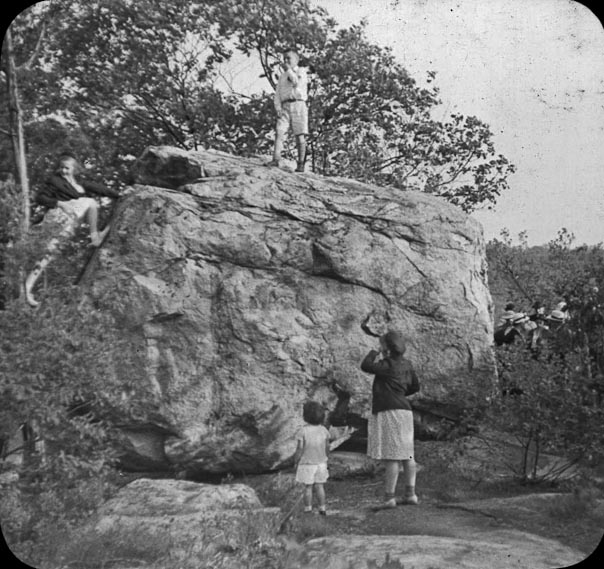
Balancing Rock, Canton, Massachusetts
(Courtesy of the Canton Historical Society)
By now you have no doubt created a short list of sites to visit in Canton that demonstrate some of the local curiosities of history and geology.  Many people have followed my recent columns and report trips to the Stone Bridge or the Indian Cave. This week we plan another “trespass” to our neighbors up on York Street.
A visit to Balancing Rock, also known as Pulpit Rock.
Photo by Eliot C. French, 1912.
(Courtesy of the Canton Historical Society)
By many names, the site is the same — Pulpit Rock, Balancing Rock, or Indian Council Rock. The subject of Indian lore, local history and today controversy, this site is among our most famous geological wonders. Located on a trail within 50 yards of the cul-de-sac at the end of Village Gate Road, the rock sits on a 60-acre parcel slated for development. Actually, not just sitting; balancing. The local developer plans to preserve the site with a small park and hopes that in doing so he will encourage the support of local opposition groups to the subsequent development of the remaining parcel. Rather than wade into the controversy, let’s focus on the rock.
Not to be taken for granite, um granted, Pulpit Rock is quite large, and was placed by the retreating glaciers atop bedrock that sits as a stone promontory 100 feet above hilly land and glacial till. The exact coordinates on the GPS place us at 71d26m W, 42d10m N. The land was part of the Colonial era site known as the “Great Sheep Pasture Lot.” But, in terms of time, the significance extends back to 14,000 years ago when the Neponset River Valley was formed by the waters of glacial melt. It may be hard to imagine today, but the Neponset River was more than a mile wide and swelled to a lake wider than five miles in the Neponset Basin.
Enormous significance is given to our area by professional and amateur archaeologists. Paleoamerican artifacts that date to 10,000-12,000 BP (years before the present) have been discovered in Canton, and in one site more than 2,600 tools and projectile points have been unearthed. Canton was rich in the tools and food needed by early man to survive in a hostile and harsh New England environment. There is little doubt that prehistoric man in New England called Canton home.
Pulpit Rock serves as a superb reminder of the people that inhabited this area thousands of years before the “contact period,” that time of European contact with native populations. There is, however, no person with greater curiosity in the history of this site than the owner and developer, Patrick Considine. Many stories abound as to the importance of Pulpit Rock, and recently new and exciting theories of use and significance have emerged.
To understand the new theories about Pulpit Rock you have to understand its owner, Pat Considine. Growing up on the family farm in North Clare, Ireland, Mr. Considine was familiar with ancient stone ring forts, dolmens and megaliths. As a boy he learned that “stone formations are an important part of the history of man.” And so when he began purchasing the land off York Street that contained Pulpit Rock, he was constantly trying to square off between folklore and history. Sometimes both are so intertwined it is impossible to separate the two.
Over the past five years as Mr. Considine amassed the 60-acre parcel, he was on a continuous path to learn more about Pulpit Rock. There is little written about this site. Some theories suggest that the Puritan missionary John Eliot used Pulpit Rock as his “pulpit” to preach his cross-cultural mission of converting the native population to Christianity. The area now known as Canton was once part of Eliot’s second so-called Praying Towns — a place where the Native Americans could live apart from the English and rule themselves as a Christian society. Eliot writes “though our poore Indians are much molested in most places in their meetings in way of civilities, yet the Lord hath put it into your hearts to suffer us to meet quietly at Ponkipog for which I thank God, and am thankful to yourself and all the good people of Dorchester.”
Katherine Sullivan, then president of the
Canton Historical Society,and Edward Bolster
 lead a visit to Balancing Rock in 1972.
 (Courtesy of the Canton Historical Society)
The Indians that settled on the 6,000 acres of the Ponkapoag Plantation certainly would have been familiar with Pulpit Rock. It is a commanding site across the land and a promontory from which folklore claims smoke signals could be seen in Sharon. But folklore was not enough for Mr. Considine, who felt the site had more significance than what had been handed down through local stories. He asked himself how he would “approach an investigation” that linked the site to pre-historic times — something that seemed elusive. On a beautiful autumn day Mr. Considine traveled to Exeter, New Hampshire and visited the New Hampshire Technical Institute and began researching standing stone sites in New England.
The seminal work on standing stones is titledManitou and tells the story of ancient Native American ritual sites across New England. The book was written by two established scientists who researched archaeoastronomy. This was the first book to examine a class of data that was ordinarily overlooked by prehistorians and is widely described as “a new research paradigm.” In Europe, especially Ireland and Britain, stone circles and megalith sites have been studied extensively for almost 50 years. In the United States, the SunWatch site near Dayton, Ohio, may date to the 1100s.
In December, Mr. Considine invited several individuals from the New England Antiquities Research Association (NEARA) to learn more about the prehistoric nature of Pulpit Rock. NEARA was founded in 1964 and has had plenty of experience supporting and debunking stone sites. Along on that day was Dr. Frederick Martin from Dedham. Dr. Martin is a research physicist who graduated from Yale and is active in the field of ion optics. Near the end of the day, almost as the group was leaving the site, Mr. Considine pointed out a row of stones ten feet from an ancient stone wall. These stones had been a curiosity to Mr. Considine, and the folks from NEARA became excited when they placed them in context with Pulpit Rock.
The row of stones, six feet in dimension, was aligned in the same direction and moved by humans. The second stone was what they termed a Manitou. Manitou is a word that is used by Algonquin speaking people to mean “spirit,” and these stones have been discovered across the New England landscape. The Manitou is similar in shape to a Colonial headstone and placed in places of great spiritual power. At Pulpit Rock the series of stones is aligned with magnetic north, and the theories that are emerging include the fact that this site may have been used to keep track of the passage of a year and possibly in connection with ceremony.
“There is a stone on which you can stand and see the Winter Solstice sun set over Pulpit Rock,” Dr. Martin said. “There is another stone that allows you to see the moon set at predictable intervals.” In essence, a straight line of monuments in which there are several unequivocal sightlines for annual and lunar timekeeping. A ceremonial stone clock, if you will allow the description.
What excites Mr. Considine is the fact that Pulpit Rock is quite similar and in his words “preeminent” to other sites with almost identical features. By mid-winter at the period of solstice late in the day, a deep shadow crosses the Manitou at Pulpit Rock and marks the darkest part of the year. Amazingly, the stones may line up to true north as it was over 10,000 years ago while today it sits off-axis by less than a few degrees.
Dr. Martin is working on publishing his findings in the journal Time and Mind, which specializes in archeoastronomy and prehistoric symbolic landscapes. He terms the site as fascinating and says that “since agriculture on bedrock is impossible, and colonial farmers are not known to be interested in the moon, it may be concluded that the stone row was constructed before the arrival of Europeans in New England.” The discovery in Canton is exhilarating in that it helps explain the long tradition of folklore and sacredness of a site long held so by modern people. The connections of Pulpit Rock to ancient people who were aligned by lunar and seasonal calendars is emerging as a very important reason for the site to be preserved.
This story originally appeared in the Canton Citizen on April 7, 2011.